
Cat Peeing Over Edge of Litter Box: What to Check
Cat peeing over edge of litter box can mean a box setup problem or a painful urinary tract. Check posture, entry, and back wall, and know the emergency signs.
Cat peeing over edge of litter box is not necessarily a refusal to use the box. She may be standing higher than the box was designed for, turning in a space that is too short, or hurting when she squats. Check the urinary signs first, then look at the box as a set of separate measurements: entry, back wall, turning space, litter depth, and position.
This is general information, not veterinary advice, and it does not replace an exam with your vet. A cat who strains and passes little or no urine needs an emergency veterinarian now, before any box experiment; other urinary signs need a same-day call.
Is this an emergency?
Start with the cat, not the litter. Cornell's Feline Health Center lists difficult or painful urination, increased frequency, crying out while urinating, blood in the urine, and urination outside the box as lower urinary tract signs. It also says a cat with urethral obstruction will often show those signs but pass little or no urine and become increasingly distressed, and that "a urethral obstruction is an absolute emergency, requiring immediate veterinary treatment" (Cornell Feline Health Center).
Contact an emergency veterinarian now if she is straining and producing only drops or no urine. Call your vet today for the other urinary signs: repeated trips to the box, crying, licking her genital area, or blood in the urine. A cat who is merely aiming over the edge but urinates a normal amount and seems comfortable can be observed more calmly, though a first episode still deserves a call if you are unsure.
Is she standing, squatting, or missing?
Watch one visit without interrupting her. Note the position of her back end, where the urine lands, and whether she steps fully into the box or keeps her hind feet on the rim.
VCA lists "standing while defecating or urinating instead of squatting" among the behavior changes that can indicate pain in an aging cat (VCA). That does not mean every standing cat has arthritis. Some cats have always stood; others stand because the box is shallow, because the litter is uncomfortable, or because a covered box touches their back. The useful question is whether the posture is new, whether it comes with other pain signs, and whether the urine stream clears the box.
A cat who squats normally but still lands outside may have a box that is too short for her body, a back wall that is too low, or a habit of facing the opening. A cat who stands and sprays backward may need a higher wall at the back, not a higher wall at the front.
What in the box changes where the urine lands?
Think of the box as five separate variables. Change one at a time.
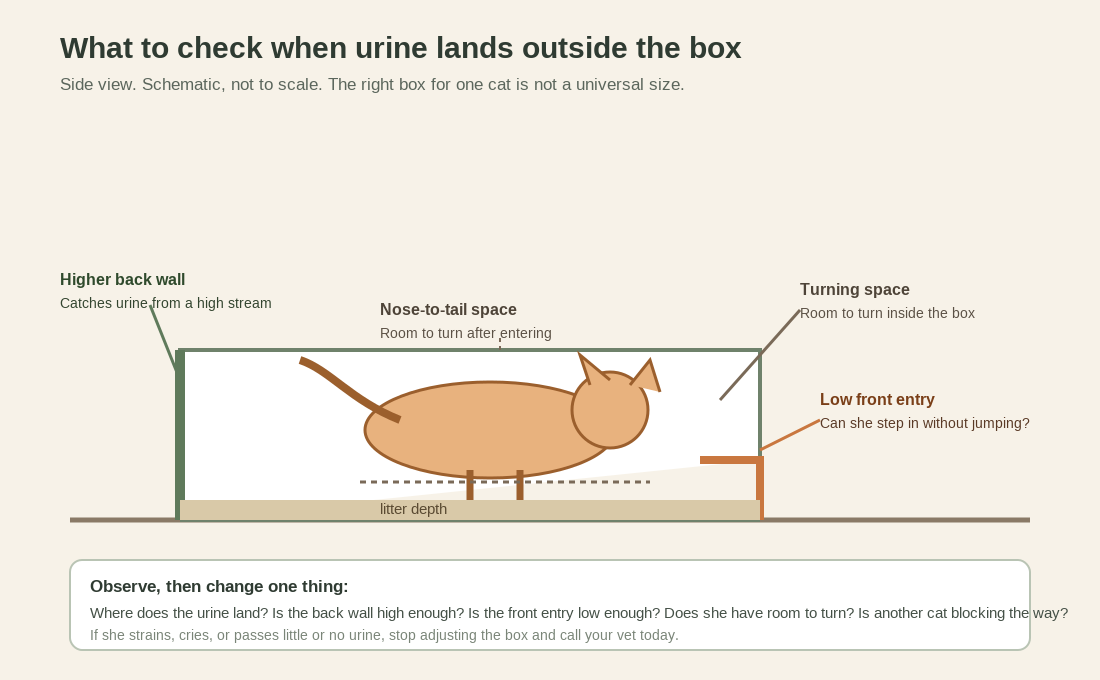
| Variable | What it affects | What to observe |
|---|---|---|
| Entry height | Whether she can step in without jumping | Does she pause, hop, or avoid the box? |
| Back wall height | Whether a high stream clears the box | Is the urine on the wall, floor, or outside the back? |
| Turning space | Whether she can turn around after entering | Does she back out, or turn with her hind end over the edge? |
| Litter depth | Where she stands and how she digs | Is the litter so deep that she sinks, or so shallow that she digs to the floor? |
| Box position | Whether she feels exposed or blocked | Is the box in a dead end, a corner, or a traffic path? |
A box that is too small shows up in the turning space more often than in the entry. A box that is too shallow shows up at the back wall. A covered box can make both worse for a cat with a sore back, because the opening can touch her as she enters.
Can a low entry and a high back wall coexist?
Yes, and for some older cats that is the useful combination. The front needs to be low enough to step over; the back and sides can be higher to catch urine. The two measurements solve different problems, so a box with a low front and a higher back can be the right combination.
The diagram below shows the parts to check. It is a schematic, not a size chart; there is no universal entry height or box length that fits every cat.
Ways to get that combination without buying a new box:
- use a storage container and cut a low doorway in one side, leaving the other three sides high;
- place a small step or ramp in front of a box with a higher rim;
- turn an existing box so the low side faces the open room and the high side faces the wall;
- add a clip-on high back or a washable panel to a box that is otherwise the right size.
Do not cut a box while the cat is in it, and do not leave a sharp edge. If you use a container, check that the plastic is not brittle and that the opening is wide enough for her shoulders.
What if another cat blocks the box?
A box can be the right size and still be unusable if another cat guards the route. International Cat Care describes conflict that can be as subtle as staring or positioning the body between another cat and a resource, and recommends one resource per cat plus one extra, spread out in different locations (International Cat Care). A single large box in a dead-end hallway can become a guard post even when it is clean.
Watch whether the older cat waits until the other cat is asleep, whether she approaches the box and turns away, or whether she uses a different spot when the other cat is nearby. If the route is the problem, add a second box in a different room and a second exit from the box area. Do not block the older cat's only route to prove a point.
What should I change first?
If the urinary signs are absent and the cat is comfortable, change the variable that matches the urine pattern:
- Urine on the floor at the front: the entry may be too high, or she may be backing out because the box is too short. Try a lower front first. If urine still lands at the front after several days, give her more turning space in a second trial.
- Urine on the wall behind the box: the back wall may be too low for her stream. Try a higher back panel instead of a higher front.
- Urine over the side: the box may be too narrow, or she may be standing with her hind end over the edge. Try a wider box first. If urine still clears the side, add a higher side panel in a second trial.
- Urine in the same corner every time: watch the route and the other cats before changing the box.
Give one change several days. Use the observation sheet, or the filled example, to record the box, its position, the posture, the urine location, and what changed. The file does not require an email address.
VCA's house-soiling guidance recommends litter, location, and box trials and says medical causes should be considered first (VCA). A trial is only useful if the other variables stay still. If the cat is also urinating in other places, the outside-box guide covers the wider causes. If the question is which box to buy, the senior litter box guide compares the trade-offs. If the cat has urinary signs, read the FLUTD note and call your vet.
When to call the vet
Call your vet today for any of the other urinary signs above, for a cat who seems to be in pain, or for a cat who is not eating or is hiding. If the aim improves with a box change but she still seems uncomfortable, or if she is standing to urinate and has other mobility changes, call and describe the change; ask your vet how soon she should be seen rather than waiting for a fixed week. If you cannot find a box setup that works, ask for help. Straining with little or no urine remains an emergency: go now.
CatWatch, an independent newsletter produced with Cornell's Feline Health Center, notes that arthritis or vision problems may call for a box that is easier to step into or moved to a more reachable place, and that a nightlight can help an older cat, especially if the box is tucked away in a closet or cubbyhole (CatWatch). Those are comfort changes; they do not diagnose the cause. The cat still needs an exam if pain is suspected.
Do not give her a human pain reliever while you wait. Acetaminophen (paracetamol, Tylenol) and ibuprofen are toxic to cats, and VCA notes that cats are especially sensitive to acetaminophen (VCA). Ask your vet about cat-specific pain relief.
Frequently asked questions
Why does my cat stand in the litter box but pee outside?
She may be standing because squatting hurts, because the box is too shallow, or because she has always stood. First rule out urinary and pain signs, then watch where the urine lands and which box dimension matches it.
Is a low entry with high sides a good litter box for an older cat?
It can be, if the front is easy to step over and the back and sides catch urine. The entry and the back wall solve different problems, so check both rather than buying the highest-sided box you can find.
My older cat is peeing standing up. Is it arthritis?
Not necessarily. Standing can be a pain sign, but it can also be a habit or a box problem. A new stance with stiffness, reluctance to jump, or changes in grooming is worth a vet visit. If the stance appeared gradually and she still jumps and grooms normally, watch the box setup first and write down what changes.
Should I get a covered box to stop urine from going over the edge?
A cover may contain spray, but it can also make the box harder to enter and touch a sore back. Try a higher back and a lower front first, and watch whether she uses the box comfortably.
How long should I wait before changing the box again?
Give one change several days of normal use. If the urine pattern has not changed and the cat is comfortable, change the next variable. If she is straining or passing little or no urine, go to an emergency clinic now. If she seems to be in pain but is urinating normally, call your vet and ask how soon she should be seen.
Watch the back end
I would watch one visit before changing the box again: where her back end is, where the urine lands, and whether she steps fully inside. That one look tells you which measurement to change next.
Sources
- Cornell Feline Health Center, Feline Lower Urinary Tract Disease (read 22 October 2026).
- VCA Animal Hospitals, How to Recognize Pain in Aging Cats (read 22 October 2026).
- VCA Animal Hospitals, Acetaminophen Toxicity in Cats (read 22 October 2026).
- CatWatch, produced in collaboration with Cornell University College of Veterinary Medicine Feline Health Center, When Your Cat Avoids the Litterbox (read 22 October 2026).
- VCA Animal Hospitals, Cat Behavior Problems - House Soiling (read 22 October 2026).
- International Cat Care, Multi-cat households (read 22 October 2026).