
Moving With an Older Cat: Set Up the First Room
Moving with an older cat works best in stages: a safe room before the van, a covered carrier, and one familiar room at the new home.
Moving with an older cat is easier when you stop thinking of it as one day and start thinking of it as a sequence of small, familiar rooms. Set up a quiet room in the old home before the van arrives, move her in a covered carrier, and give her one familiar room at the new home before she sees the rest of the house. Plan the move around her, at her pace.
I am not a vet. This is how I would plan a move for my own cat; the medical calls, especially about eating, urination, and pain, belong to your vet. If she refuses all food for about a day, or stops eating and seems unwell, or hides and will not come out for food, call your vet. If she has trouble breathing or strains and passes little or no urine, go to an emergency clinic now.
What should I set up before moving day?
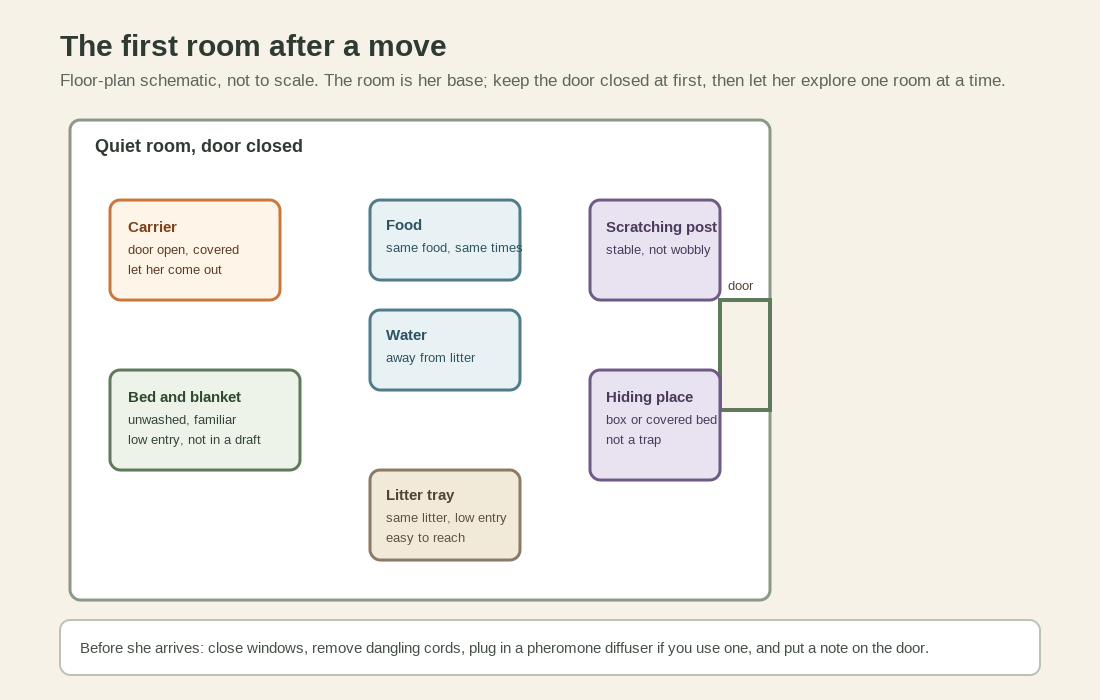
Choose one room in the old home, often a bedroom, and make it hers before the boxes take over. International Cat Care recommends keeping the cat confined there before the removal van arrives, with her carrier, bed, blanket, food bowl, water bowl, scratching post, and litter tray. Put a notice on the door so the removal team and the family know to keep it shut (International Cat Care).
Think about where that room's furniture will go in the new home. The same bed, blanket, and litter tray can become the first room there, and the familiar smell is part of the point. Keep the door and windows closed, and check for gaps, loose screens, or open vents before she goes in.
If she is on medication or a special diet, pack those separately and keep them with her. Do not put her food or medicine in a box that goes on the van.
How do I transport her?
Use a secure carrier, not a cardboard box or a laundry basket. Put a familiar blanket inside, and cover the carrier with a light blanket during the car ride if she is stressed, leaving room for air. International Cat Care says not to transport the cat in the removal van or the trunk of the car; the carrier should be in the car, secured with a seatbelt or in the rear footwell (International Cat Care).
On a long journey, the guide suggests offering water or a chance to use the litter tray at a safe stop, though most cats will not be interested. Never open the carrier in an unsafe place, and never leave her in a hot car. If she is prone to motion sickness, ask your vet before the move; do not give a sedative on your own.
What does the first room need?
The first room should have the same categories as the old safe room: food, water, litter, a bed, a hiding place, and something to scratch. Keep the food and water away from the litter. Put the litter tray on an easy route with a low entry, especially if she is stiff. A pheromone diffuser can be plugged in a few hours before she arrives if you use one.
The staged checklist lists the same setup in order, from the old home to the first two to three weeks. It does not require an email address.
The room should be quiet, warm, and free of dangling cords, plastic bags, and boxes she could get trapped behind. Check the windows and screens. If the room has a closet, close it or check it before she goes in; a frightened cat can find a gap you did not know was there.
Do not fill the room with the whole house's clutter. A few familiar objects and a clear path are more useful than a maze of boxes.
How do I let her explore?
Let her come out of the carrier on her own. Sit quietly in the room, offer food, and do not pull her out. Once the removal is finished, International Cat Care suggests letting her investigate the rest of the house, keeping exploration to one room at a time if she shows signs of stress (International Cat Care).
Keep her indoors for at least two to three weeks, the guide advises. Provide small, frequent meals, keep the routines from the old home, and continue the pheromone diffuser in the first room. Update her microchip details and her ID tag with the new address before she goes outside, and make sure her vaccinations are current.
For an older cat, add the senior-cat basics: a low litter box, water on the floor she uses, a warm bed out of drafts, and a route that does not require jumping. Cornell's Feline Health Center recommends easy access to food, water, and litter so an older cat does not have to climb stairs (Cornell Feline Health Center). The comfort at home guide covers the daily setup, and the hiding guide covers a cat who withdraws after the move.
What if there are other cats?
Move the cats together if possible, and set up the first room with resources for each cat. Do not expect them to sort out the new territory on their own. International Cat Care's multi-cat guidance recommends one resource per cat plus one extra, spread out in different locations, and separate feeding areas (International Cat Care).
If the cats are already tense, the move can make it worse. Keep the older cat's room as a rest stop, feed the cats on opposite sides of a door, and reintroduce them gradually. The return-home plan for a vet visit is a useful model: separate, scent exchange, short supervised contact. If the tension continues, ask your vet or a behavior professional before you change the household further, such as adding another cat or rearranging shared rooms. If a sitter will manage the first days, the senior cat sitter checklist covers the handoff.
When should I call the vet?
Go to a vet or an emergency clinic now if she has trouble breathing, open-mouth breathing, or strains and passes little or no urine. Call your vet today if she stops eating, hides and will not come out, or seems to be in pain. Cornell's Feline Health Center calls urethral obstruction an absolute emergency (Cornell Feline Health Center).
Cornell also advises getting a cat to a veterinarian right away when there is any question about her ability to breathe comfortably (Cornell Feline Health Center).
A reduced appetite for a few hours can happen if she is otherwise bright and drinking. If she refuses all food for about a day, is overweight, or is getting worse, call today; the not-eating guide explains what counts as an urgent sign. Do not wait for her to "settle in" if she is visibly unwell.
Do not give her a human painkiller while you wait. Acetaminophen (paracetamol, Tylenol) and ibuprofen are toxic to cats, and VCA notes that cats are especially sensitive to acetaminophen (VCA). Ask your vet about cat-specific pain relief.
Frequently asked questions
How long should I keep my older cat indoors after moving?
International Cat Care recommends at least two to three weeks indoors before letting her outside, and longer if she seems unsettled. Use the time to update her microchip and ID, check the new boundaries, and establish a routine.
Should I sedate my cat for the move?
Do not give a sedative without your vet. Some cats travel well in a covered carrier with a familiar blanket; others may need a vet's advice. A sedative is a clinical decision; ask your vet whether it is appropriate.
Where should the first room be?
Choose the quietest room with a door that closes, ideally one that will stay a bedroom or spare room. It should have space for food, water, litter, a bed, and a hiding place, and it should not be a pass-through room.
My older cat is hiding after the move. What should I do?
Let her hide if the spot is safe, and keep food, water, and litter nearby. Do not drag her out. If she refuses all food for about a day or seems to be in pain, call your vet. If she has trouble breathing or strains and passes little or no urine, go to an emergency clinic now.
How do I move two cats at once?
Move them together in separate carriers, set up separate resources in the first room or in two adjacent rooms, and reintroduce them gradually. Give each cat a carrier that closes, a familiar blanket, and a route that does not pass the other cat. Feed them on opposite sides of a door at first, then use short supervised contact. Do not assume they will be comforted by being together in a new space; a move can make an existing tension worse.
The first night
The first night, I would sit in the room with her for a few minutes and then let her be. The boxes can wait until morning. A cat who eats, uses the litter, and finds the bed has already started to make the new place hers.
Sources
- International Cat Care, Moving house with your cat (read 22 October 2026).
- International Cat Care, Multi-cat households (read 22 October 2026).
- Cornell Feline Health Center, Loving Care for Older Cats (read 22 October 2026).
- Cornell Feline Health Center, Feline Lower Urinary Tract Disease (read 22 October 2026).
- Cornell Feline Health Center, Dyspnea (Difficulty Breathing) (read 22 October 2026).
- VCA Animal Hospitals, Acetaminophen Toxicity in Cats (read 22 October 2026).