
Younger Cat Chasing Older Cat: Protecting Rest and Resources
Younger cat chasing older cat is not always play. Spot blocked resources, protect the older cat's rest, and know when to get help.
Younger cat chasing older cat is not always play, and the first question is not whether the younger cat is naughty. It is whether the older cat can still reach food, water, litter, rest, and you without being followed, blocked, or displaced. A chase can look like play from across the room and still leave the older cat sleeping in a hallway, skipping meals, or avoiding the box, so count what she can reach before you change anything.
This is general behavior information, not a diagnosis. Pain and illness can change both cats' tolerance, so a sudden change in either cat deserves a vet visit before a training plan. If the older cat is the one starting fights, the senior cat aggression note covers that separate pattern.
Is it play or pressure?
Play between cats is usually quiet, has pauses, and lets both cats choose the next move. One cat may chase, then the other may chase back; they separate, shake off, and return to normal. If one cat is always the chaser and the other is always the one who leaves, hides, flattens, or hisses, the game is not mutual.
International Cat Care describes conflict that can be easy to miss: staring or blocking access to resources, following, chasing, ambushing, or pouncing to displace another cat from an area or a resource (International Cat Care). The page also notes that these behaviors can escalate to hissing, growling, biting, scratching, chasing, and wrestling. A younger cat who stops when the older cat signals is different from one who keeps going after the older cat has left. An older cat hiding from a younger cat is easy to miss when the hiding spot is a favorite chair.
Watch who starts, who ends, and whether the older cat comes back afterward. A cat who returns to the same room and resumes grooming is a good sign. A cat who stays under the bed, skips a meal, or waits until the younger cat is asleep to use the box is a cat to watch.
What does the older cat lose first?
When a younger cat won't leave the older cat alone, the older cat usually loses the resource that is easiest to guard: a doorway, a litter box in a dead end, a food bowl in a corner, a warm bed, or your lap. The loss can be subtle. A cat may not be injured; she may simply stop using the best spot and start using a worse one.
International Cat Care recommends one resource per cat plus one extra, placed in different locations. Litter trays grouped together count as one resource, and feeding areas should be separated with a visual barrier or in different rooms, with bowls away from corners so a cat can face away or in any direction (International Cat Care). That formula is a starting point. The older cat also needs a route to each resource that does not pass through the younger cat's favorite ambush spot. The multi-cat feeding guide shows how to separate food when the cats need different diets, and the comfort at home guide covers the older cat's floor-level resources.
How do I map the house?
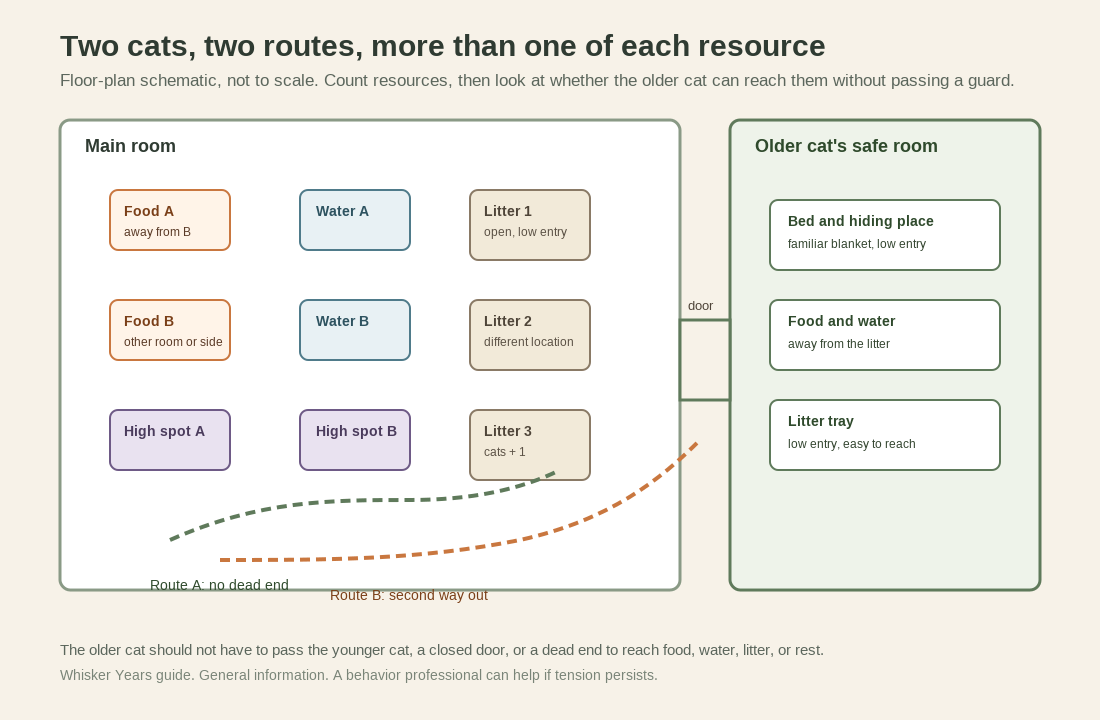
Draw a simple floor plan with the rooms, doors, and the resources. Mark where each cat eats, drinks, sleeps, scratches, and uses the litter. Then draw the routes the older cat takes. Look for three things:
- A dead end. A box or bed in a corner with one exit is easy to guard.
- A single route. If the older cat must pass the younger cat to reach water or the litter, add a second route or a second resource on the other side.
- A resource cluster. Two boxes side by side, or food and water together, can function as one contested spot.
The diagram below is a schematic, not a prescription. The point is to see the routes, not to reproduce the exact layout.
Use the blank event log or the filled teaching example to record the time, who started, what the other cat did, which resource was blocked, how long it lasted, and what happened. The files do not require an email address.
What can I change this week?
Start with the resources and the younger cat's exercise, not with punishment.
- Separate the food. Feed the cats in different rooms or behind a visual barrier, and pick up the bowls afterward. A younger cat who finishes first can otherwise guard the older cat's bowl.
- Add a litter box in a different room. Put it on the older cat's route, with a low entry and an exit that is not a dead end.
- Add a second water source. Water away from food and away from the litter gives the older cat another option.
- Give the older cat a safe room. A room the younger cat cannot enter, with a bed, water, litter, and a door that closes, is a rest stop rather than a prison. Let the older cat choose when to come out.
- Give the younger cat a real play outlet. A few short wand-toy sessions and food puzzles can meet some of the chasing need. End play with a meal or a calm activity, and do not use the older cat as the toy.
- Separate the play sessions. Play with the younger cat in another room while the older cat rests. If the older cat wants to play, give her a low, slow session of her own.
VCA's guidance for cats that do not get along starts with a veterinary exam for both cats, then adequate resources, enrichment, pheromones, and a gradual reintroduction if tensions are high (VCA). It also notes that medication may be discussed with a veterinarian if behavior does not improve. That is a clinical decision for your vet.
When is it not a training problem?
A sudden change in either cat's behavior can be medical. VCA lists aggression toward other pets as one of the behavior changes that can accompany pain in an aging cat (VCA). The older cat may be sore, losing hearing or vision, or less able to send clear social signals. The younger cat may be in pain, bored, or overcrowded.
Book a vet visit if the older cat is hiding more, eating less, missing the box, or reacting defensively when touched. Ask about both cats, not just the one who is chasing. If the behavior continues after the health check and the resource changes, ask your vet for a referral to a qualified behavior professional. Do not wait for a fight to cause an injury. If the older cat is hiding and not eating, or a fight leaves either cat injured or unable to get away, call your vet or an emergency clinic today.
What not to do
- Do not spray, hit, shake, or scold either cat. Punishment can make the younger cat more aroused and the older cat more afraid.
- Do not let them "work it out" if one cat is hiding or unable to leave.
- Do not add a third cat as a playmate for the younger one. A third cat adds another relationship and more resources to manage, and it is not a reliable fix for chasing.
- Do not lock the older cat in a small room all day. A safe room should be a choice she can leave.
- Do not assume the older cat is fine because she is not fighting back. Avoidance is a cost too.
Frequently asked questions
Is the younger cat playing or bullying the older cat?
Play is mutual and pauses; pressure is one-sided. If the older cat hides, avoids the box, or stops eating after a chase, treat it as pressure even if the younger cat looks playful.
Why does my younger cat block the litter box?
The box may be in a dead end, or the younger cat may be guarding a route. A cat blocking the litter box is often guarding a doorway, so add a second box in a different location and a second exit, and watch whether the older cat uses it.
Will getting another cat help the younger cat leave the older one alone?
A third cat adds another relationship and more resources to manage. It is not a reliable fix for chasing, so fix the current resources and the younger cat's play needs first.
Should I separate the cats permanently?
A safe room and separate resources can be part of the plan, but permanent separation is a last resort. Start with a vet check for both cats, then add resources in different locations and a route the older cat can use without passing the younger one. If tensions stay high after those changes, ask your vet for a referral to a qualified behavior professional who can design a gradual reintroduction. Do not leave them together to work it out if one cat is hiding or cannot get away.
When should I see a vet or behaviorist?
See a vet for a sudden change, pain signs, appetite or litter changes, or a cat who is hiding and not coming out. See a behavior professional if the tension continues after the health check and resource changes, or if either cat is being injured.
Watch one evening
I would watch one evening before changing the whole house: who follows whom, which doorway the older cat avoids, and whether she comes back to the room afterward. The cat who returns is telling you the most.
Sources
- International Cat Care, Conflict between cats (read 22 October 2026).
- International Cat Care, Multi-cat households (read 22 October 2026).
- VCA Animal Hospitals, Managing Cats & Kittens That Don't Get Along (read 22 October 2026).
- VCA Animal Hospitals, How to Recognize Pain in Aging Cats (read 22 October 2026).