
Cat Litter Stuck to Paws: Help for Older Cats
Cat litter stuck to paws can be loose grains, a wet clump, or a sore paw. A safe check-and-clean order for older cats, and when to call your vet.
Cat litter stuck to paws is usually a tracking problem, but in an older cat it can also be the first visible sign that standing in the box has become uncomfortable. Start with the paw, not the litter: loose grains brush off, a soft clump can be softened and removed, and a paw that is red, swollen, bleeding, or painful needs a vet. The check order below takes a few minutes and tells you which of those you have.
This is general care information, not a diagnosis. A cat with a sore paw, a changed gait, or trouble urinating needs an examination, and the cause may sit above the paw.
What does the litter on the paw look like?
Look at the pads, the spaces between the toes, the nail beds, and the back of the paw. The same gray dust can mean three different things.
| What you see | What it may mean | First action |
|---|---|---|
| Dry grains on the fur or floor | Ordinary tracking | Brush or shake them off over the box |
| A soft, damp clump between the toes | Wet litter has packed into the fur | Soften it with a lukewarm damp cloth, then lift it away |
| A hard clump, matted fur, or litter pressed against the skin | The clump has dried or the cat is not grooming the foot | Stop pulling; a groomer or vet may need to clip the fur |
| Redness, swelling, a cut, discharge, or a paw she will not let you touch | Possible injury or infection | Call your vet rather than finishing the cleanup |
A cat who keeps licking one paw after using the box is telling you the paw feels wrong, even if you cannot see a clump. Note which paw and when the licking started.
Why is this more common in an older cat?
Older cats are less mobile, and joint pain can make it hard to reach the hind feet or hold a leg still long enough to clean between the toes. International Cat Care notes that cats in their senior years may need grooming help because they are less mobile, especially when joint pain from arthritis makes the necessary positions uncomfortable (International Cat Care). VCA reports that osteoarthritis affects more than 90% of cats 10 years of age and older, and lists standing while urinating or defecating instead of squatting among the signs of pain (VCA).
A litter box that is hard to enter can add to the problem. A cat with sore hips may step in awkwardly, pause in wet litter, or stand with her back close to the wall. Cornell's CatWatch notes that a cat with arthritis or vision problems may need the box moved or a box with an easier step-in (Cornell CatWatch).
None of that means the litter on the paw is proof of arthritis, kidney disease, or diabetes. It means the paw and the box are worth checking, and a cat who is also drinking more, losing weight, or urinating outside the box should see a vet.
How do I remove it without hurting her?
Work in a quiet room with good light. Put a towel on the floor and let her stand on it rather than holding her leg in the air. If she will not tolerate the handling, stop; a second person or a vet visit is safer than a struggle.
- Brush off what is loose. Use your fingers or a soft brush. Do not pull on a clump that is stuck to fur.
- Soften a damp clump. Hold a lukewarm, wet cloth against the clump for a minute, then try to lift it away. Re-wet the cloth rather than tugging.
- Do not cut near the skin. Scissors and fingernails are a poor match for a cat's thin paw skin. If the clump is tight or the fur is matted, ask a groomer or vet to clip it.
- Dry the paw. Pat it dry and check between the toes again. A little loose litter can stay on the floor; a clump pressed into the pad cannot.
- Reward and stop. A treat and a quiet exit teach her that the paw check is not a fight.
VCA's footpad first-aid guidance says to leave deeply lodged debris alone and let a veterinarian remove it, because digging can worsen the injury and cause pain (VCA). The same restraint applies to a hard litter clump: if it does not soften and lift away, it is no longer a cleaning job.
When should I stop and call the vet?
Stop the cleanup and get help if:
- she cries, flinches, or will not let you touch the paw;
- the paw is red, swollen, hot, bleeding, or has a discharge or bad smell;
- a clump is embedded in the pad or the skin is broken;
- she is limping, holding the paw up, or licking it constantly;
- she is straining to urinate, crying while urinating, or passing little or no urine;
- she has stopped eating or seems suddenly weaker.
Straining with little or no urine is not a wait-and-see sign. Contact an emergency veterinarian now, before cleaning, changing litter, or finishing a log. Most other urinary signs need a same-day call, but a cat who is straining and passing little or no urine should be seen immediately. Cornell's Feline Health Center describes difficult or painful urination, increased frequency, crying out, blood in the urine, and urination outside the box as lower urinary tract signs, and calls urethral obstruction an absolute emergency that needs immediate veterinary treatment (Cornell Feline Health Center). Do not wait to see whether the paw problem resolves first.
Do not give her a human pain reliever while you wait. Acetaminophen (paracetamol, Tylenol) and ibuprofen are toxic to cats, and VCA notes that cats are especially sensitive to acetaminophen (VCA). Ask your vet about cat-specific pain relief.
How do I keep it from coming back?
Change one factor at a time. If you change the litter, the box, the mat, and the grooming routine in the same week, you will not know which one helped.
Start with the least disruptive change:
- Scoop more often. Wet litter is more likely to pack into fur than dry litter.
- Check the litter depth. Too much loose litter can spill over the paw; too little can make a cat dig harder. Keep the depth consistent for a few days.
- Look at the entry. A low front step is easier on sore hips, but a box that is too small can leave her standing in the litter with her back to the wall.
- Add a mat at the exit. A flat, easy-to-step-over mat catches loose grains before they reach the floor. Avoid a deep-pile mat that is hard for an old cat to walk on.
- Ask about grooming. If the fur between the pads is long or matted, a groomer or vet can trim it. Do not trim it yourself with scissors. The senior cat grooming note covers brushing and mats, and the litter choice guide covers materials.
- Have the pain checked. If she is standing to urinate, reluctant to jump, or grooming less, the paw may be the visible part of a joint problem.
VCA's house-soiling guidance recommends litter, location, and box trials when a cat is avoiding the box, and notes that medical causes should be considered first (VCA). CatWatch makes the same point about litter changes: most cats want the same litter, location, box style, and cleaning schedule, so changes should be made in increments (Cornell CatWatch).
What should I write down?
Use a one-change log so the next conversation with your vet starts with facts instead of a guess. Record the date, the cat's name, the one thing you changed, what stayed the same, what the paw looked like before, what it looked like 24 hours later, and anything else worth noting.
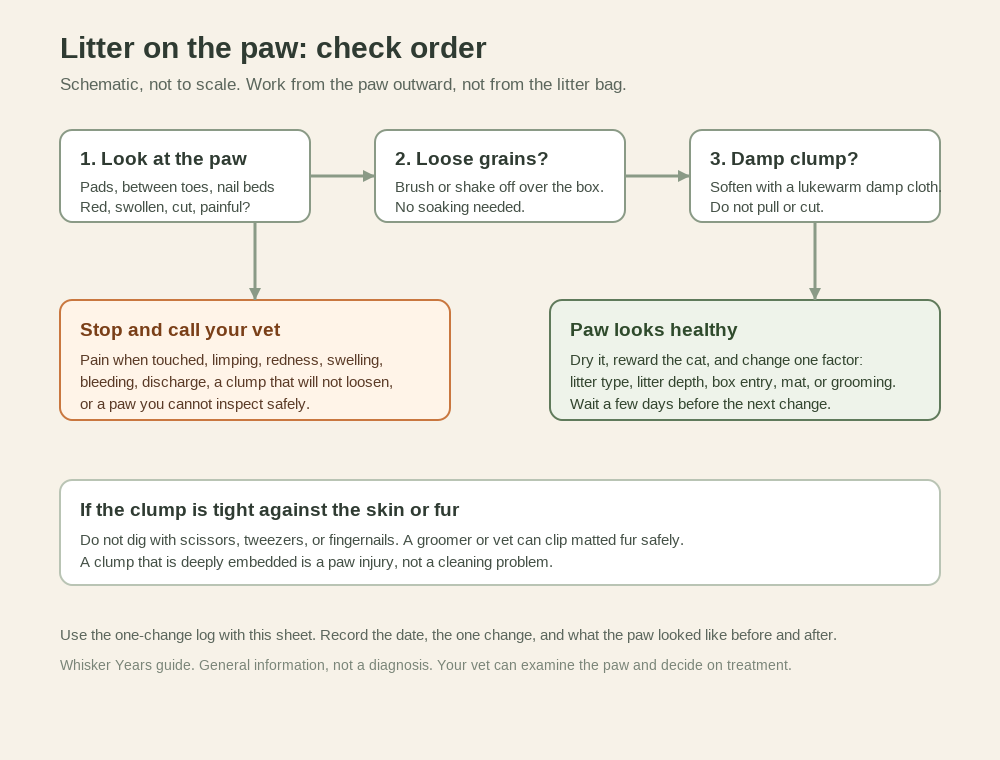
Download the blank one-change log or the filled example. The files do not require an email address. The schematic check-order diagram shows the same sequence in one page; it is a guide, not a clinical photo.
Frequently asked questions
Should I change cat litter if it keeps sticking to her paws?
Change one thing first, not the whole setup. A larger-particle litter may produce fewer fine grains, but a sudden switch can cause its own box aversion. Try one box with the new litter, keep the location and cleaning schedule the same, and give it several days. If the tracking improves, you have your answer. If the paw still collects litter or looks sore, stop changing the box and ask your vet.
Is clumping litter stuck between the toes an emergency?
Not by itself. A soft clump that lifts away after a warm cloth is a cleaning task. A hard clump pressed into the skin, a red or swollen paw, bleeding, or a cat who will not let you touch the foot needs a vet.
Why is my older cat getting litter stuck to her back paws?
Back paws are harder to reach when hips and knees are stiff. Arthritis, weight gain, and a box that is hard to enter can all make the hind feet harder to clean. The litter is the visible part; the mobility is worth checking.
Can I use scissors to cut the litter out of the fur?
No. Cat paw skin is thin and a moving cat is not a safe cutting surface, so ask a groomer or vet to clip matted fur.
When should I call the vet instead of cleaning at home?
Call if the paw is painful, swollen, bleeding, or damaged; if a clump will not soften; or if she is limping or licking constantly. If she is straining and passing little or no urine, go to an emergency clinic now. Other urinary signs, such as crying or increased frequency, need a same-day call. A paw problem and a urinary problem can appear in the same week, and the urinary one can be urgent. If the litter is outside the box rather than on the paw, the senior cat peeing outside the litter box guide covers the wider causes.
The paw is the message
Cat litter stuck to paws is usually a cleaning job, and sometimes it is the first thing you can see of a sore joint or a box that has become hard to use. I would clean the paw gently, change one thing, and write down what the next day looks like. If the paw is sore, the clump will not soften, or she is showing urinary signs, the next step is your vet.
Sources
- International Cat Care, Everyday care for your cat (read 22 October 2026).
- VCA Animal Hospitals, How to Recognize Pain in Aging Cats (read 22 October 2026).
- Cornell CatWatch, When Your Cat Avoids the Litterbox (read 22 October 2026).
- VCA Animal Hospitals, Cat Behavior Problems - House Soiling (read 22 October 2026).
- VCA Animal Hospitals, First Aid for Torn Footpads in Cats (read 22 October 2026).
- VCA Animal Hospitals, Acetaminophen Toxicity in Cats (read 22 October 2026).
- Cornell Feline Health Center, Feline Lower Urinary Tract Disease (read 22 October 2026).