
Muscle Wasting in Cats: Why Senior Cats Lose Muscle, and How to Spot It
Muscle wasting in cats can happen even when the scale holds steady. Sarcopenia vs cachexia, where to feel for it first, and when muscle loss means a vet visit.
Muscle wasting in cats, which a vet may also call muscle atrophy, is one of the quieter changes of old age, and one of the easiest to miss, because it does not always show up on the scale. A senior cat losing muscle can hold a perfectly steady weight while her body quietly trades lean muscle for fat, so the number stays put even as she grows bonier along the back. It comes in two kinds worth telling apart: the slow muscle loss of aging itself, and the faster loss driven by an illness like kidney disease. Learning to feel for it, rather than trusting the scale alone, is how you catch it while there is still something to do.
This is a guide to noticing and understanding cat muscle loss, not a diagnosis. Whether your own cat's is simple aging or a sign of disease is a question for your vet, and the difference matters.
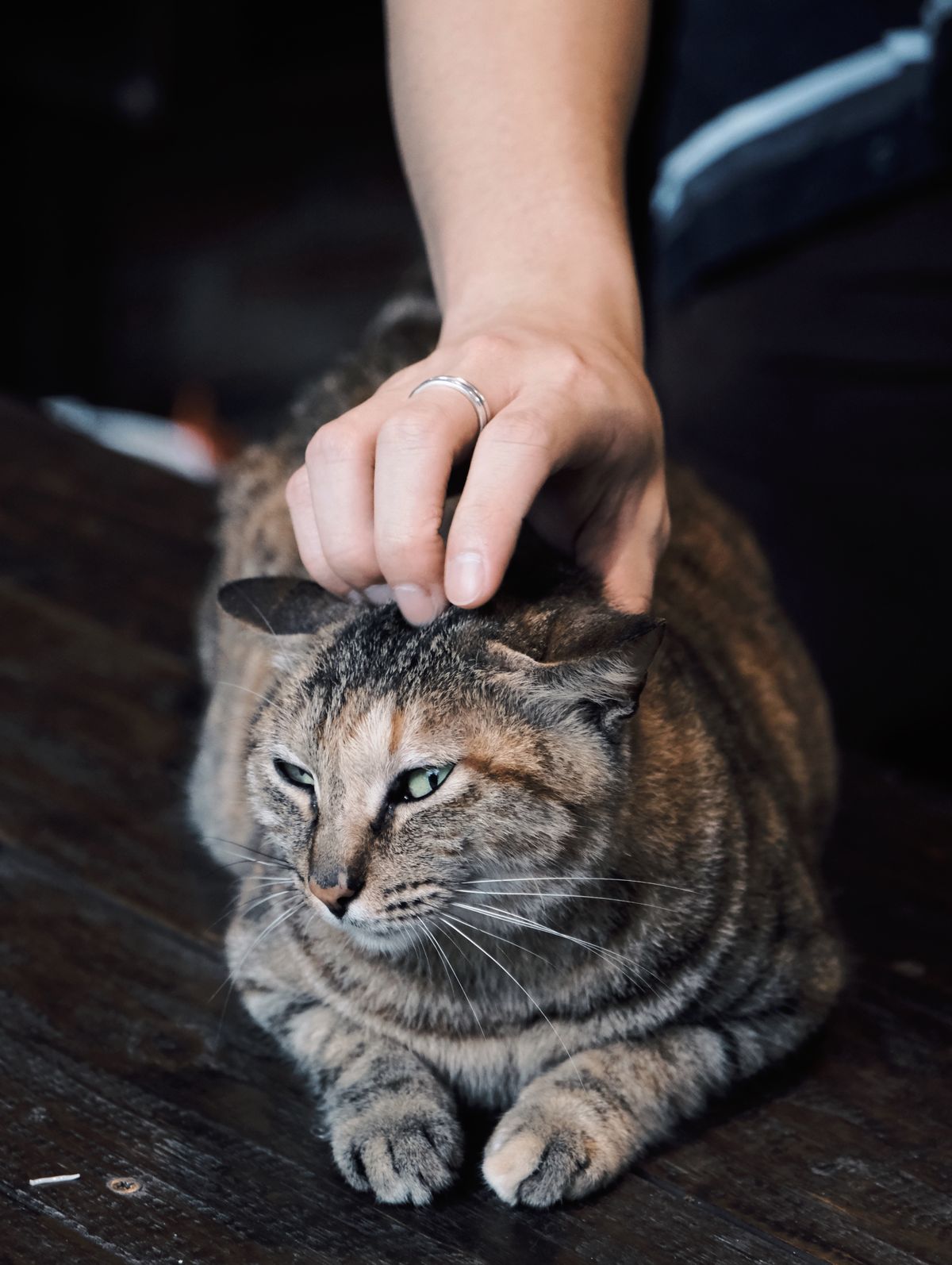
The short version: muscle condition is not the same as body weight, and a cat can be a normal weight, or even overweight, and still be losing serious muscle. Age-related loss is called sarcopenia; disease-driven loss is called cachexia, and it points at conditions like kidney disease, an overactive thyroid, or cancer. The earliest place to feel it is the muscle on either side of the spine. Persistent or rapid muscle loss deserves a vet visit, because muscle loss is not just cosmetic.
Why is my old cat losing muscle?
Because muscle loss has two separate engines, and old age can run either. Tufts' veterinary nutrition team draws the line clearly: muscle loss is common in animals as they age (where it's called sarcopenia) and when they're sick or injured (where it's called cachexia). Sarcopenia is the ordinary wear of the years, a gradual loss of lean tissue that comes with getting old. Cachexia is muscle burned off by illness, and it tends to move faster. Neither is harmless. As Tufts puts it, cachexia and sarcopenia are not just cosmetic: muscle loss makes an animal weaker, depresses immune function, and reduces the ability to recover from illness, surgery, or injury. That is the reason to pay attention to it rather than filing it under "just old."
Sarcopenia or cachexia: age, or disease?
The practical question is which of the two you are looking at, because it changes what happens next. Sarcopenia, the age kind, comes on slowly in an otherwise well cat and is managed mostly through diet and staying active. Cachexia, the disease kind, is the one to rule out, since it rides along with several of the illnesses common in older cats: the wasting of chronic kidney disease, the calorie-burning of an overactive thyroid, heart disease, and cancer. The tell is usually pace and company: muscle that seems to be melting away over weeks, or muscle loss alongside a fading appetite, more thirst, or weight coming off the scale too, leans toward the disease kind and earns a work-up.
| Sarcopenia | Cachexia | |
|---|---|---|
| Driven by | Aging itself | An underlying illness |
| Pace | Slow, over months to years | Often faster, over weeks to months |
| The cat is otherwise | Generally well | Usually showing other signs |
| Common in | Most old cats, to some degree | Kidney disease, thyroid disease, heart disease, cancer |
| What it needs | Good protein, gentle activity | Treating the disease behind it |
You cannot always tell from the scale
It is tempting to assume a cat has to be skinny to be losing muscle, and that is simply not how it works. Tufts is blunt about it: dogs and cats can even be overweight and still have significant muscle loss, and, the other way around, animals can be thin but have normal muscle mass. Muscle and fat are two different things, and the scale weighs them together. A cat losing muscle but not weight is quietly swapping one for the other, so her weight holds while her body changes underneath it. That is why weighing her, useful as it is for tracking weight loss, does not tell the whole story. You have to assess the muscle itself.
Where to feel first: the muscle condition score
Vets grade muscle with a simple tool you can learn at home. The muscle condition score in cats works the same way it does in any pet, and as Tufts explains, the muscle condition score, as the name implies, specifically assesses a pet's muscle, separately from body fat. It is determined by feeling your pet's muscles over her back, head, shoulders, and hips, and there is one spot that changes first. As Tufts notes, the muscles over the back, just on each side of the spine, are the earliest site affected by muscle loss so that's the first place to check. Run a flat hand gently down her back beside the spine: full, rounded muscle is normal, and bone that is becoming easy to feel is not. The scale itself is graded simply, as normal, or as mild, moderate, or severe muscle loss. For a precise reference, the standard charts are the World Small Animal Veterinary Association's muscle condition score charts, developed at The Cummings School of Veterinary Medicine at Tufts University.
What helps: protein, and treating the cause
For the age-related kind, the answer is not to feed less. An old cat holding muscle needs plenty of good protein, and cutting her food back only speeds the loss. VCA notes that dietary protein is a critical nutrient for maintaining good physical health in the face of aging, and notes that some older senior cats may need an increase in their caloric and protein intake to sustain a normal physique as their body condition and weight naturally decline with advanced age. There is more on getting that right in feeding a senior cat, and gentle movement, the little bit of play she will still do, helps hold what muscle she has. For the disease-related kind, the muscle follows the illness: the real fix is diagnosing and treating whatever is burning it off, which is why muscle loss that comes on fast or with other signs belongs in front of a vet.
When does muscle loss start, and how fast does it go?
Earlier than most of us would guess, and then faster than we expect. The best measurement comes from the Cat Prospective Ageing and Welfare Study, a UK cohort of 209 pet cats examined every six months for up to seven years and published in Frontiers in Veterinary Science. On its 30-point muscle score, the cats slipped from 30 to 28 between the ages of seven and ten, and then dropped to 15 by sixteen. The authors put the turning point plainly: After age 10, the cats had a greater probability of mild muscle loss than no muscle loss, and by age 14, they were more likely to be underweight than obese. Disease steepened the slope: Cats that developed chronic disease had a greater age-related decline in all three metrics, meaning weight, body condition, and muscle together, which is the cachexia story in numbers.
The same cohort's seven-year mortality analysis is the part I keep coming back to. Cats who already showed muscle loss at middle age had roughly twice the hazard of dying over the study compared with cats who did not, and the authors' conclusion is that targeted strategies to promote healthy aging should start from middle age. I read that as an argument for running a hand along the spine of a seven-year-old cat, not only a fourteen-year-old one. The wider set of figures from that study is in senior cat health statistics.
Can muscle wasting in cats be reversed?
Partly, and it depends on the kind. For age-related loss, the honest answer from the sources above is that it can be slowed and, with enough protein and some activity, some of it can be held or rebuilt; VCA's line that some older senior cats may need an increase in their caloric and protein intake to sustain a normal physique is the closest thing to a prescription. I have not found a feline study that measures how much muscle an old cat regains once it is gone, so I will not put a number on it. For disease-driven loss, the muscle follows the illness: treat the kidney disease, the thyroid, or the heart, and the wasting slows with it; how much of the lost muscle returns depends on how far the disease can be brought under control. Either way, the useful move is the same one, which is to catch it early, when there is more muscle left to keep than to rebuild.
When to see the vet
Book a visit if you can feel your cat's spine, shoulder blades, or hips becoming prominent, if the muscle over her back has gone from full to bony, or if the change is quick. Go sooner if the muscle loss keeps company with a fading appetite, more drinking, weight dropping on the scale, or low energy, since that pattern points at a disease rather than plain age. Some muscle loss is an ordinary part of growing old, but it is worth having your vet decide that, rather than assuming it, because the treatable kind looks much the same from the outside.
Frequently asked questions
Why can I feel my cat's spine? Because the muscle that normally pads either side of the backbone is the first to go when a cat loses muscle, so a spine that has become easy to feel is often an early sign of muscle wasting. In a senior cat it can be ordinary aging (sarcopenia) or a sign of illness (cachexia), so it is worth a vet check, especially if the change is recent or she has other signs.
Can a cat lose muscle but not lose weight? Yes, and this is the trap. Tufts notes that dogs and cats can even be overweight and still have significant muscle loss, because muscle can be replaced by fat while the scale holds steady. That is why muscle has to be assessed by feel, over the spine and hips, rather than judged by weight alone.
Is muscle loss in old cats normal? Some is. Age-related muscle loss, sarcopenia, is common in older cats and to a degree expected. But it is not harmless, and it looks much like the faster muscle loss caused by disease, so a vet is the one to tell ordinary aging from a condition that needs treating.
Why is my cat losing muscle in her hind legs? The back legs often look thinner first because their muscle is large and easy to see, but the earliest loss is usually over the spine, so check there too. Thin hind legs with actual weakness, wobbling, or a crouched walk are a different matter from plain muscle loss and point at conditions like low potassium, diabetes, or arthritis, which are covered in weak back legs in a senior cat.
How do I know if it is age or illness? Pace and company are the clues. Slow loss in a cat who is otherwise well leans toward aging; loss that comes on over weeks, or arrives with a poor appetite, more thirst, weight loss, or low energy, leans toward an illness like kidney or thyroid disease. Your vet sorts it out with an exam and bloodwork.
Sources
- Tufts Petfoodology, Cummings School of Veterinary Medicine, What's Your Pet's Score? Assessing Muscle Condition
- VCA Animal Hospitals, Feeding Mature, Senior, and Geriatric Cats
- Frontiers in Veterinary Science, 2025, Longitudinal changes in bodyweight, body condition, and muscle condition in ageing pet cats (full text)
- Frontiers in Veterinary Science, 2026, Patterns of morbidity, multimorbidity, and mortality in aging cats: findings from seven years of the Cat Prospective Ageing and Welfare Study (full text)