
Hairballs in Senior Cats: How Often Is Too Often?
Hairballs in senior cats: Cornell puts once every week or two in the normal range. Why old cats get more, what actually prevents them, and blockage signs.
Hairballs in senior cats sit in an awkward place: common enough to be boring, and occasionally the thing that lands a cat in surgery. Cornell's Feline Health Center gives a usable threshold, saying it is not uncommon for a cat to bring one up once every week or two, and that's nothing to worry about. What complicates that number in an old cat is that she is both more likely to produce hairballs and more likely to have something else going on.
The short version: roughly one hairball every week or two is within normal range, per Cornell. Older cats tend to produce more of them, not fewer, because they have spent a lifetime becoming thorough groomers. Repeated retching that brings nothing up, or a cat who is lethargic and off her food for more than a day, is a vet call rather than a hairball. And the popular hairball remedies are laxatives, which Cornell says should not be given without veterinary approval.
This explains the numbers and the warning signs. It is not a diagnosis of your own cat, and anything sudden belongs with your vet rather than with an article.
How often are hairballs normal in cats?
Cornell's own threshold is the most concrete one published by a veterinary school: a hairball once every week or two, and that's nothing to worry about. Below that, there is nothing to think about. Around that, watch rather than worry.
The number moves with the cat. Cornell notes that Long-haired breeds - such as Persians and Maine Coons - are at significantly greater risk than short-haired breeds, and that the development of hairballs is more frequent in seasons of the year when cats shed their coats. A rise in early autumn or spring, in a cat who is otherwise herself, usually has a coat behind it rather than a disease. If her coat has changed in other ways too, what a senior cat's coat can tell you covers that separately.
Worth knowing before you settle on a number: the two authorities this site leans on most do not draw the line in the same place. Cornell's is the week-or-two figure above. VCA's is stricter, advising that if your cat is vomiting hairballs more than once a month, contact your veterinarian. That is a real gap rather than a rounding difference, and there is no way to reconcile it that does not involve picking one. For an old cat, the stricter line is the more useful default, because the list of things that cause vomiting grows with her age and the cost of checking is one appointment.
What matters more than either threshold is the direction of travel. A cat who has produced one hairball a month for years and now produces one a week has changed, and the change is the information, whichever side of a published figure she sits on.
Do older cats get more hairballs?
Usually yes, and the reason is unflattering to younger cats. Cornell puts it plainly: Kittens and young cats are less apt to develop hairballs than older cats that, as well-experienced groomers, are likely to spend a good portion of their waking hours busily licking their coats. Decades of practice make a cat efficient at swallowing her own fur.
An old cat complicates that tidy story, because two things run in opposite directions as she ages. She is a better groomer, so more hair goes in. But an arthritic cat often grooms less because twisting hurts, which is why a neglected, greasy coat is a sign worth taking seriously rather than laziness. Which of those is happening in your cat changes what the hairballs mean, and a cat who suddenly stops producing them while her coat goes ragged is telling you something as clearly as one who starts producing more.
The other senior-specific catch: in an older cat, vomiting is more often disease than it is in a young one. The same weekly episode that reads as ordinary in a three-year-old deserves a harder look at fourteen, which is the whole argument of the guide to senior cat vomiting.
Can you actually prevent hairballs?
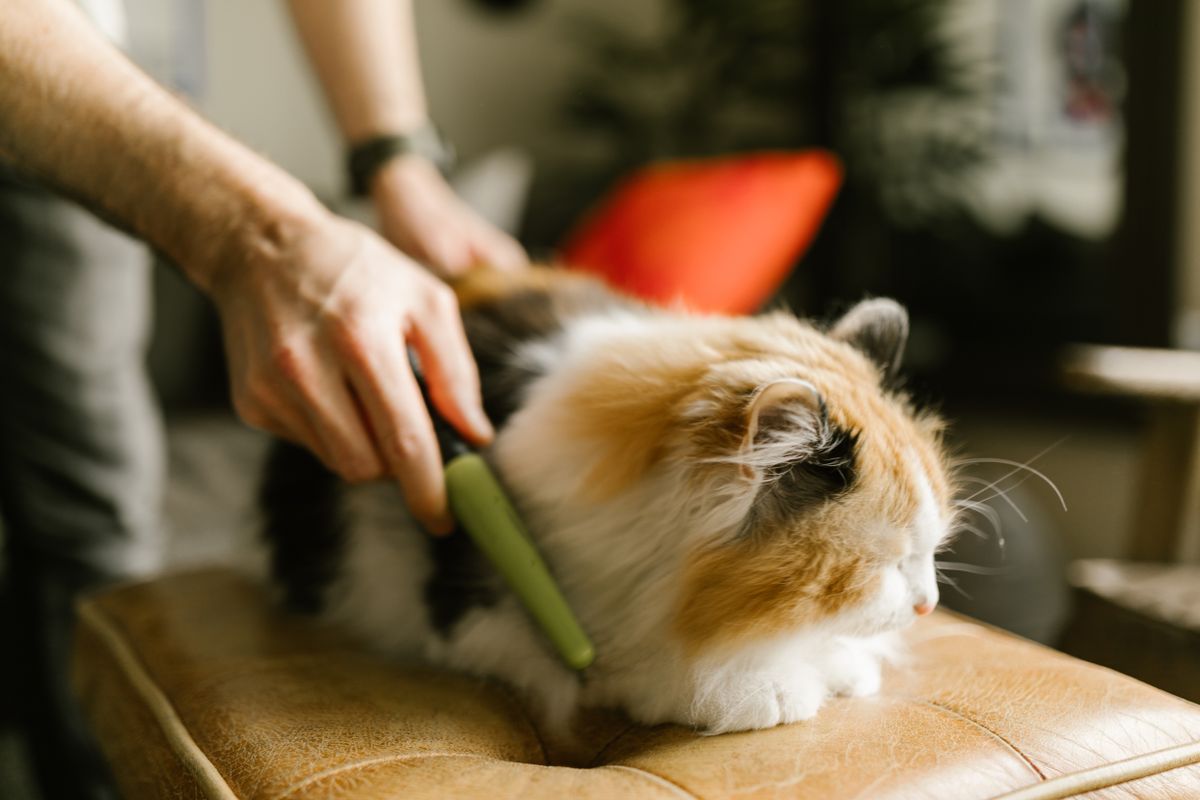
One measure has no argument against it. Cornell's advice starts with the comb: Get your cat accustomed to a daily brushing and combing, on the simple logic that fur on the brush is fur that never reaches her stomach. For a stiff old cat who can no longer reach her back end, your brushing is doing work she cannot do herself. Timing helps too: since hairballs cluster in the shedding seasons, as noted above, the weeks when fur is coming off in drifts are the weeks the comb earns its keep.
If she will not tolerate brushing, and plenty of arthritic cats will not, there is a blunter option. Cornell suggests you take her to the veterinarian or a reputable groomer for a haircut once or twice a year, which is especially worth considering for a long-haired cat whose coat is beginning to mat. More on handling a coat she can no longer manage is in grooming a senior cat.
One piece of housekeeping gets overlooked. Cornell advises owners to keep the floors of your home free of thread, paper clips, twist-wraps, and other materials that, if ingested, can become dangerous hairball ingredients. A hairball wrapped around a length of thread is a different and worse problem than a hairball alone.
The most important measure, though, is not a product or a brush at all. VCA puts it first among prevention strategies: The most important prevention strategy is to work with your veterinarian to address any underlying intestinal disease. For a senior cat this is the whole game. A cat with inflammatory bowel disease or an overactive thyroid moves hair through her gut differently, and a cat with itchy skin who has started overgrooming is swallowing more hair in the first place. Treating those does more than any tube will.
What a hairball remedy actually does
Nothing dissolves the hair. That is worth saying plainly, because the products are often described in language that implies otherwise.
Cornell explains why hair persists at all: its main structural component is a tough, insoluble protein substance called keratin, and the cat's digestive tract makes no impression on it. The normal route is simply through: While most of the swallowed hair eventually passes through the animal's digestive tract and gets excreted intact in the feces, some of it remains in the stomach and gradually accumulates into a damp clump.
So a hairball remedy is a lubricant, and Cornell's own description of the category is a mild petroleum-based laxative. It is meant to help hair finish the journey it was already making. The hair leaves in the litter box either way; the tube is a bet about how easily.
Do cats need hairball remedies?
The evidence here is thinner than the shelf space, and it points somewhere slightly different from where you might expect.
Published feline hairball research exists, and it is almost entirely about dietary fiber rather than about the petroleum pastes. Five studies make up most of it: work on sugarcane fiber and cellulose in 32 cats, on beet pulp in 18, on Miscanthus grass fiber in 12, on a keratin-digesting enzyme combined with sugarcane fiber in 24, and an earlier trial of a nutritional approach. I am summarizing rather than quoting them because their pages do not render their text to an ordinary visitor, so you could not check my wording against them.
Three things are worth knowing about that body of work. The groups are small, twelve to thirty-two cats. The outcome measured is usually how much hair comes out in the feces, which is a reasonable proxy but is not the same as how often a cat vomits at home. And the 2021 enzyme study opens by acknowledging that raising dietary fiber is a strategy to reduce hairball formation but is not fully effective.
For the petroleum jelly pastes themselves, across six differently worded searches of the veterinary literature I found no published feline trial. That is a statement about what I could locate rather than proof that none exists, and it is the honest position: the product most people reach for is the one with the least published work behind it, while the approach with actual studies behind it is fiber in the food.
Which sets up a genuine knot rather than a tidy answer. Cornell's Dr. Goldstein extends his caution to exactly that fiber route, warning that The same advice applies to the use of commercial diets that claim to be effective in preventing or relieving such an obstruction. The route with the most evidence is also the one a Cornell internist tells you to clear with your vet first. Both of those can be true at once, and for an old cat with other conditions, the conversation is the part that matters.
If you use one, how to use it safely
Two Cornell pages give different emphasis, and reading them as a contradiction misses the point. On one, Dr. Joanna Guglielmino recommends you Feed her a hairball remedy - usually a mild petroleum-based laxative - once or twice a week. On the other, written around the danger of blockage, Dr. Richard Goldstein strongly advises owners never to give their cats a laxative without the approval and supervision of a veterinarian.
Two vets, two contexts. Routine lubrication in a well cat is a different proposition from dosing a cat who may already have something lodged, and Goldstein's warning is the one that governs an older cat: with kidney disease, with other medication, or with symptoms right now, the vet comes first. That is a one-sentence question at a regular check-up, not a separate appointment.
How you give it matters as much as whether. Oil-based products carry a specific risk when they are forced into a cat's mouth, because a struggling cat can inhale them. A 2019 case series in a feline medicine journal described three cats with exogenous lipid pneumonia, all of which shared a history of long-term forced oral dosing with mineral oil for chronic constipation. Those are three cats, and the exposure was repeated forced dosing of oil rather than a healthy cat licking a small amount of paste, so it is not a reason to panic about a dab. It is a good reason to let her take it off your finger or her own paw in her own time, and never to syringe an oily product into an unwilling cat.
One more thing before you reach for anything. Cornell raises a possibility that is easy to miss when a cat is hacking: the frequent hacking has nothing at all to do with hairballs. It may instead, the page continues, be a sign that the animal is suffering from a serious respiratory ailment such as asthma, which needs emergency treatment rather than a lubricant. A cat crouched low with her neck extended, coughing repeatedly and bringing nothing up, may be having an asthma attack, and that one is worth knowing on sight.
What are the signs of a hairball blockage?
A hairball that stops moving is what turns a nuisance into an emergency. VCA defines the term directly: The word "trich" means hair, while a bezoar is any foreign material that obstructs the stomach or intestines. Therefore, a trichobezoar is a gastrointestinal obstruction caused by hair.
Cornell's warning signs are the ones to memorize. Call your vet without delay if your cat is lethargic and refuses to eat for more than a day or so, or has had repeated episodes of unproductive retching. Unproductive retching is the phrase worth holding onto: the heaving motion of bringing up a hairball, over and over, with nothing arriving. A hairball that comes up is doing its job. One that cannot is the problem.
Two things make this harder to read in an old cat. The retching can look almost identical to the cough of feline asthma, which Cornell notes may itself need emergency treatment, and telling a cough from a hairball attempt is its own skill covered in senior cat coughing. And an old cat who has stopped eating is in more immediate trouble than a young one, whatever the cause.
If a blockage is suspected, the workup is not guesswork. Cornell describes diagnosis resting on physical examination, bloodwork, X-rays, perhaps ultrasound, and a history of the animal's pattern of hairball regurgitation.
Does a hairball blockage always mean surgery?
No, and this is the reassuring part of an otherwise frightening section. Cornell writes that If a blockage is detected, surgery may be required in order to remove the hairball, then adds the more common path: More often, however, therapy will center on protecting the intestines through several days of clinical care that includes the use of a laxative to move the hairball through the digestive tract.
Where surgery is needed, timing decides the outcome. VCA notes that Most cats respond well to surgery if it is performed promptly, before significant intestinal damage has occurred, and that while an endoscope is occasionally an option, More commonly, the obstruction is removed via surgery. Promptly is the operative word, and it is the argument for calling on the first day of unproductive retching rather than the third.
Frequently asked questions
How often is too often for hairballs in cats? Cornell puts one hairball once every week or two, and that's nothing to worry about. More often than that, or a clear increase on her own pattern, is worth raising with your vet, particularly in a senior cat.
Do older cats get more hairballs? Generally yes. Cornell notes younger cats are less apt to develop hairballs than older cats because older cats are practiced, thorough groomers. An arthritic cat who has stopped grooming can show the opposite pattern.
What are the symptoms of a hairball blockage in a cat? Cornell flags a cat who is lethargic and refuses to eat for more than a day or so, or has had repeated episodes of unproductive retching. Retching that produces nothing, repeatedly, is the signature.
Are hairball remedies safe for cats? They are laxatives, and on Cornell's page about blockage risk, Dr. Goldstein strongly advises owners never to give their cats a laxative without the approval and supervision of a veterinarian. Ask your vet first, especially for a cat with other conditions.
Is my cat coughing or bringing up a hairball? They look alike and mean different things. A cough that produces nothing, over and again, can be asthma rather than a hairball attempt. The distinction is worked through in senior cat coughing.
The bottom line
Biscuit is sixteen and, like most cats her age, a far more diligent groomer than she was at four, which is a polite way of saying she eats a great deal of her own fur. What changed in this house was not a product but a habit: a comb, most evenings, while she is already settled and cross about being interrupted. Cornell's advice on hairballs in senior cats begins with the brush for a reason, and the tube in the cupboard is the part to ask a vet about first.
Sources
- Cornell Feline Health Center, A Hairy Dilemma
- Cornell Feline Health Center, The Danger of Hairballs
- VCA Animal Hospitals, Trichobezoars in Cats
Summarized rather than quoted, because none of these render their text to an ordinary visitor:
- Loureiro BA, Sembenelli G, Maria AP, Vasconcellos RS, Sá FC, Sakomura NK, Carciofi AC. Sugarcane fibre may prevents hairball formation in cats. Journal of Nutritional Science, 2014 (doi:10.1017/jns.2014.27)
- Loureiro BA, Monti M, Pedreira RS, Vitta A, Pacheco PDG, Putarov TC, Carciofi AC. Beet pulp intake and hairball faecal excretion in mixed-breed shorthaired cats. Journal of Animal Physiology and Animal Nutrition, 2017 (doi:10.1111/jpn.12745)
- Donadelli RA, Aldrich CG. The effects of diets varying in fibre sources on nutrient utilization, stool quality and hairball management in cats. Journal of Animal Physiology and Animal Nutrition, 2020 (doi:10.1111/jpn.13289)
- Miltenburg TZ, Peralta RM, Oliveira CAL, Janeiro V, Pereira EQ, Nicolau JTS, Ribeiro LB, Vasconcellos RS. Effects of combined use of keratinolytic enzymes and sugarcane fibre on the hairball excretion in cats. Journal of Animal Physiology and Animal Nutrition, 2021 (doi:10.1111/jpn.13177)
- Dann JR, Adler MA, Duffy KL, Giffard CJ. A potential nutritional prophylactic for the reduction of feline hairball symptoms. The Journal of Nutrition, 2004 (doi:10.1093/jn/134.8.2124s)
- Mallol C, Espada Y, Lloret A, Altuzarra R, Anselmi C, Novellas R. Dystrophic mineralisation in chronic exogenous lipid pneumonia in cats. JFMS Open Reports, 2019 (doi:10.1177/2055116919850255)