
Arthritis in Senior Cats: The Signs You Miss, and How to Help
Arthritis affects about 90% of cats over 10, yet most owners miss it. The quiet signs, how it is treated, and the home changes that help most.
Arthritis is one of the most common problems of old age in cats, and one of the most quietly overlooked. VCA puts the numbers starkly: about 90% of cats over 10 years old experience OA in at least one joint, and if you are unsure whether yours has crossed that line, the cat age calculator puts her age in human terms. It is the highest prevalence figure among the senior cat health statistics, which is why assuming some stiffness is a safer default than assuming none. Yet most of us never notice, because a cat with sore joints rarely limps in an obvious way. She just stops doing things: jumping onto the windowsill, playing, keeping her coat tidy. Once you learn to read those small changes, though, there is a great deal you can do, and a surprising amount of it is simply rearranging her world.
This is a guide to what feline arthritis looks like and how it is eased. Whether your cat has it, and what will help her most, is a conversation for your vet.
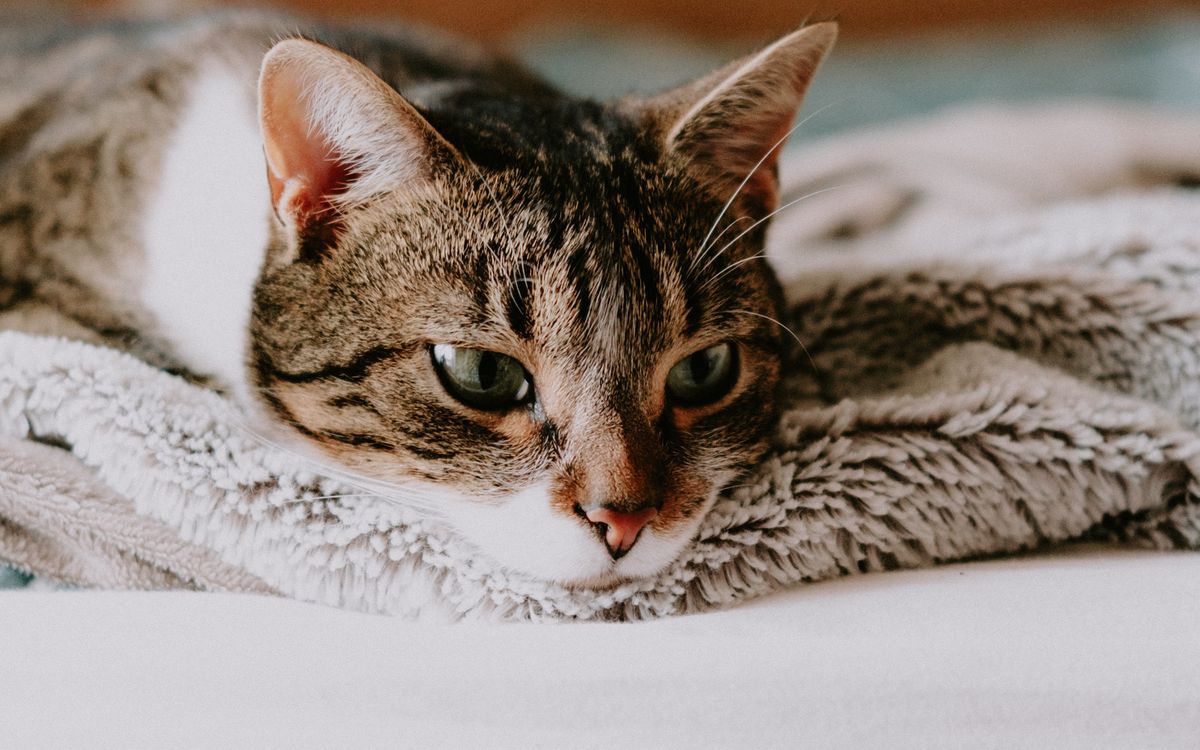
Why arthritis hides in plain sight
A dog with a sore hip will limp and tell you about it. A cat, built to conceal weakness, tends to manage her pain by doing less. So the signs read as "she's just getting old" or "she's gotten lazy," when the truth is that moving hurts. With nine in ten older cats affected, the safe assumption is not that your senior cat is the exception. It is that she has some of this, and that it is worth looking for.
The signs
The changes are subtle and easy to explain away one at a time. VCA lists the ones to watch for:
- Reluctance to jump up or down, or jumping to lower spots than she used to.
- Walking stiffly, or lameness in one or more legs.
- Reluctance to play, and sleeping more.
- Hiding more than usual.
- Poor coat condition (because self-grooming becomes difficult), and sometimes a patch she over-licks because the joint beneath it hurts.
- House soiling (if they have difficulty getting in and out of the litter box).
- Constipation, when a sore crouch makes her put off passing stool.
That last one catches many people out, since it looks like a behavior problem rather than a physical one. A cat who has started missing the box, or crying out at night when she is stiff and restless, may be sore rather than difficult.
How it is diagnosed
Your vet will watch her move, feel the joints for pain and thickening, and often take X-rays to see the changes directly. Getting a stiff cat there without a fight is half the battle, which is the argument for a carrier that opens from the top rather than one she has to be folded through. Because cats hide discomfort and do not always show the same signs on the same day, your own notes about what she has stopped doing at home are genuinely useful in the exam room.
What helps
Arthritis responds well to a combination of small, undramatic things.
- Weight. A few extra pounds land hard on sore joints, so getting an overweight cat back to a healthy weight is one of the most effective things you can do, and it is worth asking your vet to help you do it safely.
- Rearrange her home. This is the lever most in your hands. VCA suggests Provide soft, padded bedding, Raise food and water dishes to elbow height, Provide non-skid floor surfaces and Provide a ramp or stool/step for getting onto higher surfaces. A litter box with a low side she can step into rather than climb over, a set of steps up to her favorite perch, a warm bed at floor level, and food and water she does not have to crouch for all give her back parts of her day. That easy reach to water matters more in hot weather, when a cat who struggles to cross the room is slower to rehydrate. A raised food bowl spares her neck the same way at mealtimes.
- Pain relief from your vet. There are real options now. VCA lists anti-inflammatory medications (robenacoxib and meloxicam) and a newer drug, frunevetmab (Solensia), which VCA describes as an injection that lasts for a full month and which works by blocking a pain signal. Anti-inflammatories can be hard on the kidneys, so in an older cat, who often has some chronic kidney disease as well, your vet weighs them carefully. The monthly injection is part of why a cat who cannot safely take anti-inflammatories still has a real option for relief. Never give a cat human painkillers, which can be fatal to them.
- Joint support and warmth. VCA notes glucosamine, chondroitin, and omega-3 fatty acids as supplements worth discussing, and a warm, draft-free bed eases stiff joints the way it eases ours, which matters most in cold weather.
What you can do at home
Start by watching for the small retreats: the chair she no longer jumps to, the game she has quietly given up. Then make her world easy to move through, one change at a time, and keep her lean. If she is crying at night or withdrawing and going off her food, pain is one of the things on the list, so it is worth mentioning to your vet rather than putting down to age.
When to see the vet
Book a visit if your older cat is jumping less, moving stiffly, missing the litter box, or simply doing less than she used to. There is no cure for arthritis, but there is genuine relief, and a cat in less pain is a cat who comes back to more of her life.
I used to think of the way an old cat slows down as something to accept, a gentle winding-down. Some of it is. But a lot of what looks like a cat losing interest is really a cat in quiet pain, and that part we can do something about. The chair she gave up is often just one ramp away from being hers again. That is the quiet hope in arthritis in cats: the pain is common, but so are the small fixes that ease it.
Sources
- VCA Animal Hospitals, Arthritis in Cats